Chapter 7 · Lesson 23 of 38
Railroad crossings: signs and stopping
4 min read · Safe Vehicle Operation
Signs in this lesson
Figures in this lesson
Explanation
Not every crossing has every device, so know what each one means.
- Vehicles that must always stop at railroad crossings — vehicles carrying passengers for hire, school buses, and vehicles carrying explosives or flammable liquids — stop not closer than 15 feet and not farther than 50 feet from the nearest rail.
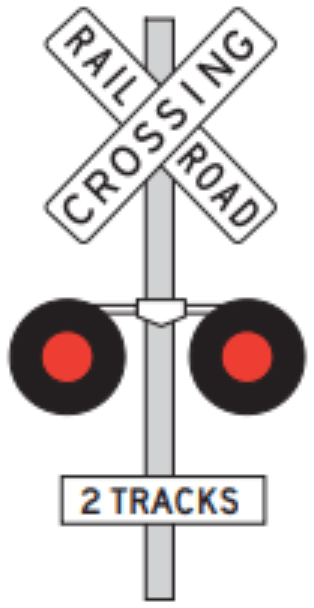
- Crossbuck alone: treat it as a yield sign. The decision to stop is yours — but you must stop if a train is approaching.
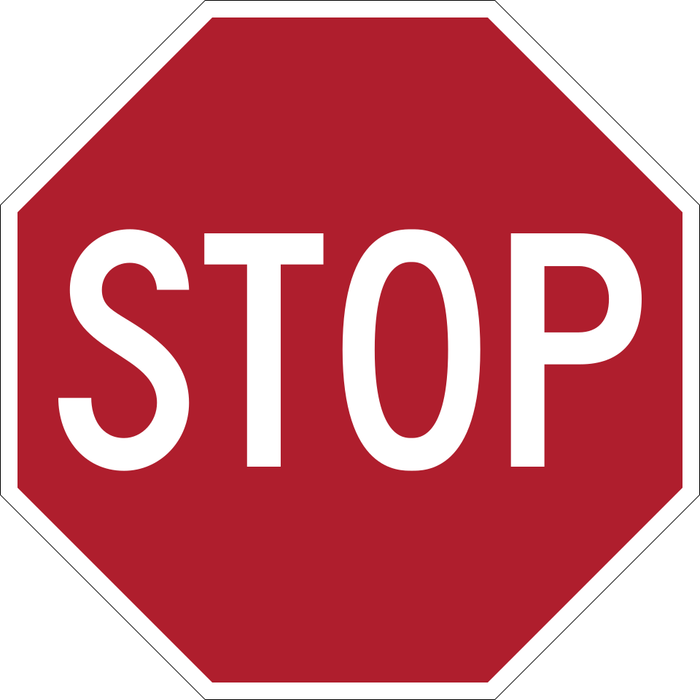
- Crossbuck with a stop sign: come to a complete stop and cross only after making certain no train is approaching. Never assume no train is coming just because there is only a stop sign.
- Active warnings (bells, flashing lights, gates): stop and stay stopped until the warning ends or a law enforcement officer or railroad flagman directs you.
- It is illegal to drive around a lowered gate. Never race a train — its speed is very deceiving.
Example
You’re behind a school bus that stops about 30 feet before the tracks even though no train is in sight. That is required for school buses. Wait behind it; don’t pass (passing within 100 feet of a crossing is prohibited).
Common mistake
Driving around a gate that is down because no train is visible. It is illegal, and the actual speed of a train can be very deceiving.
What the manual says
Some vehicles are required by law to always stop at railroad crossings not closer than 15 feet or farther than 50 feet from the nearest rail.
When displayed alone, you should treat a crossbuck as a yield sign and the decision to stop or cross the tracks is yours. You must stop if there is a train approaching.
When there are active warning bells, flashing lights, or lights and gates, you must stop and not proceed until the active warning is canceled or you are directed to proceed by a law enforcement officer or railroad flagman.
Sources
- Manual p. 48
“Some vehicles are required by law to always stop at railroad crossings not closer than 15 feet or farther than 50 feet from the nearest rail.”
- Manual p. 48
“All vehicles carrying passengers for hire”
- Manual p. 48
“All school buses”
- Manual p. 48
“All vehicles carrying explosives or flammable liquids”
- Manual p. 48
“When displayed alone, you should treat a crossbuck as a yield sign and the decision to stop or cross the tracks is yours. You must stop if there is a train approaching.”
- Manual p. 48
“When a crossbuck is displayed with a stop sign, you must come to a complete stop and proceed over the tracks only after making certain that a train is not approaching.”
- Manual p. 48
“Never assume that a train is not coming simply because there is only a stop sign.”
- Manual p. 48
“When there are active warning bells, flashing lights, or lights and gates, you must stop and not proceed until the active warning is canceled or you are directed to proceed by a law enforcement officer or railroad flagman.”
- Manual p. 48
“It is illegal to drive around a crossing gate that is down.”
- Manual p. 48
“Under no circumstances should you attempt to race a train to a crossing.”
- Manual p. 49
“Do not pass another vehicle within 100 feet of a railroad crossing.”
Check your understanding
Question 1 of 3